
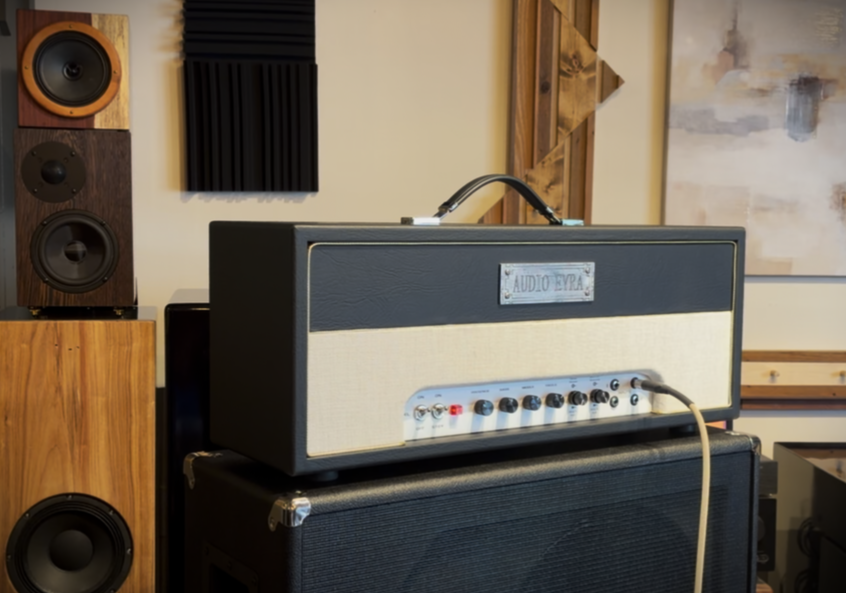
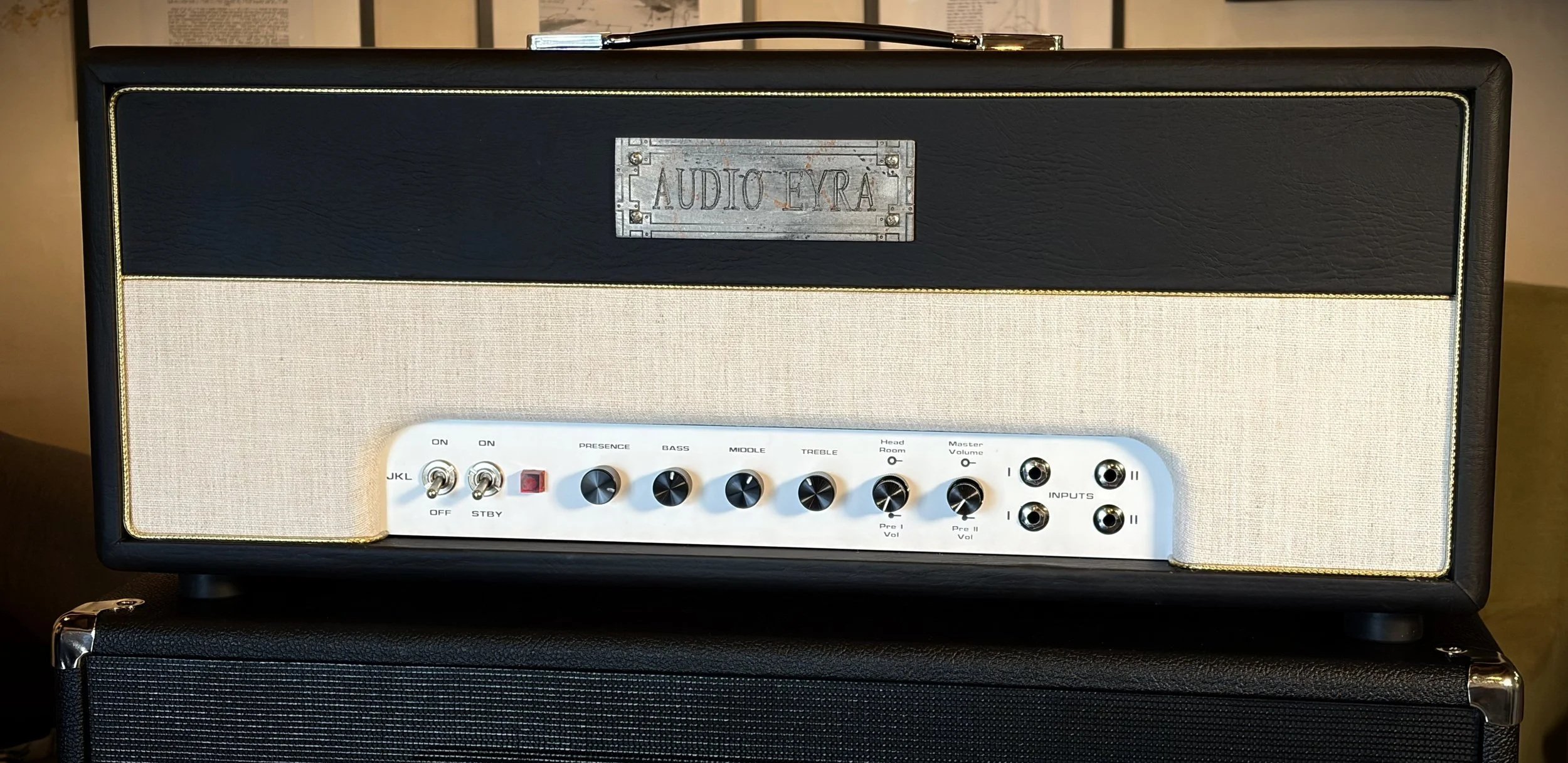
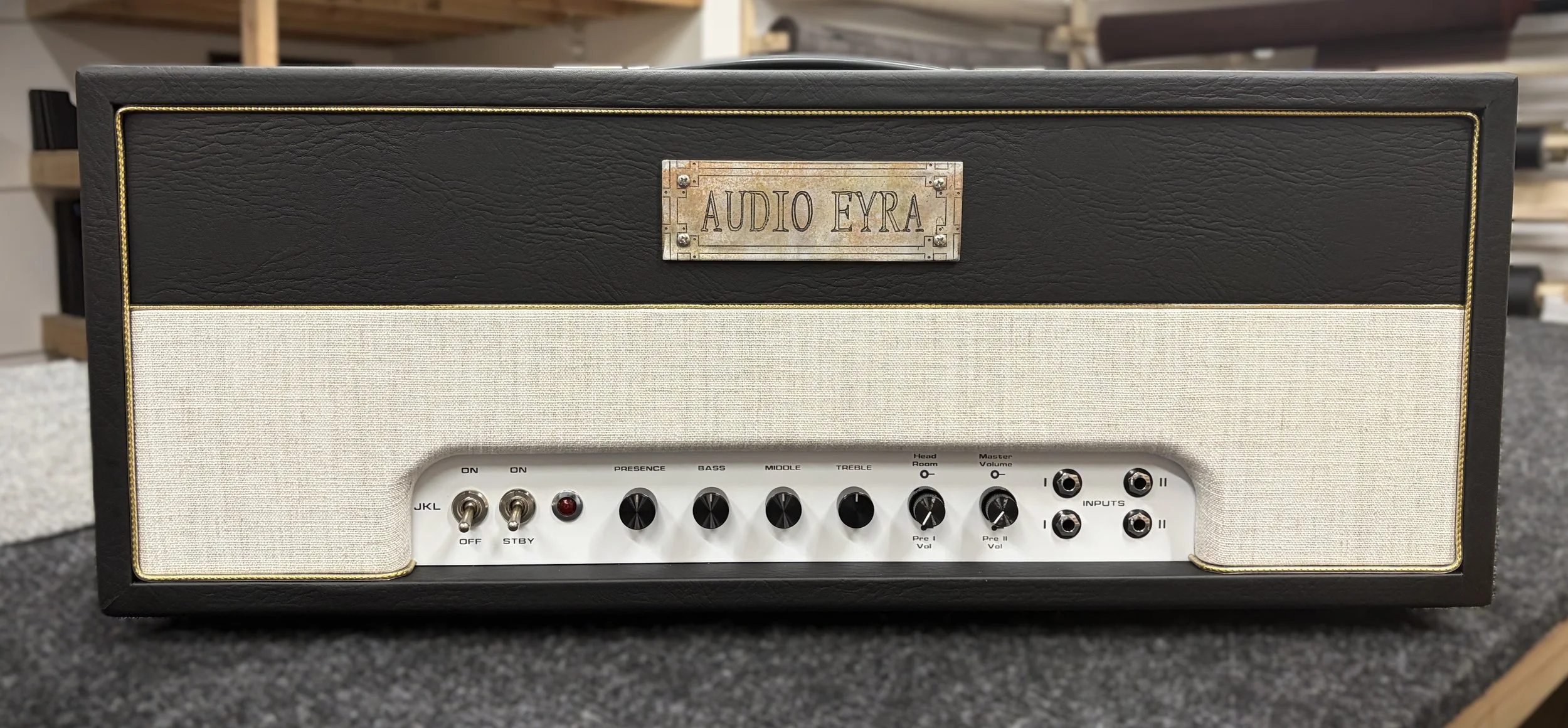
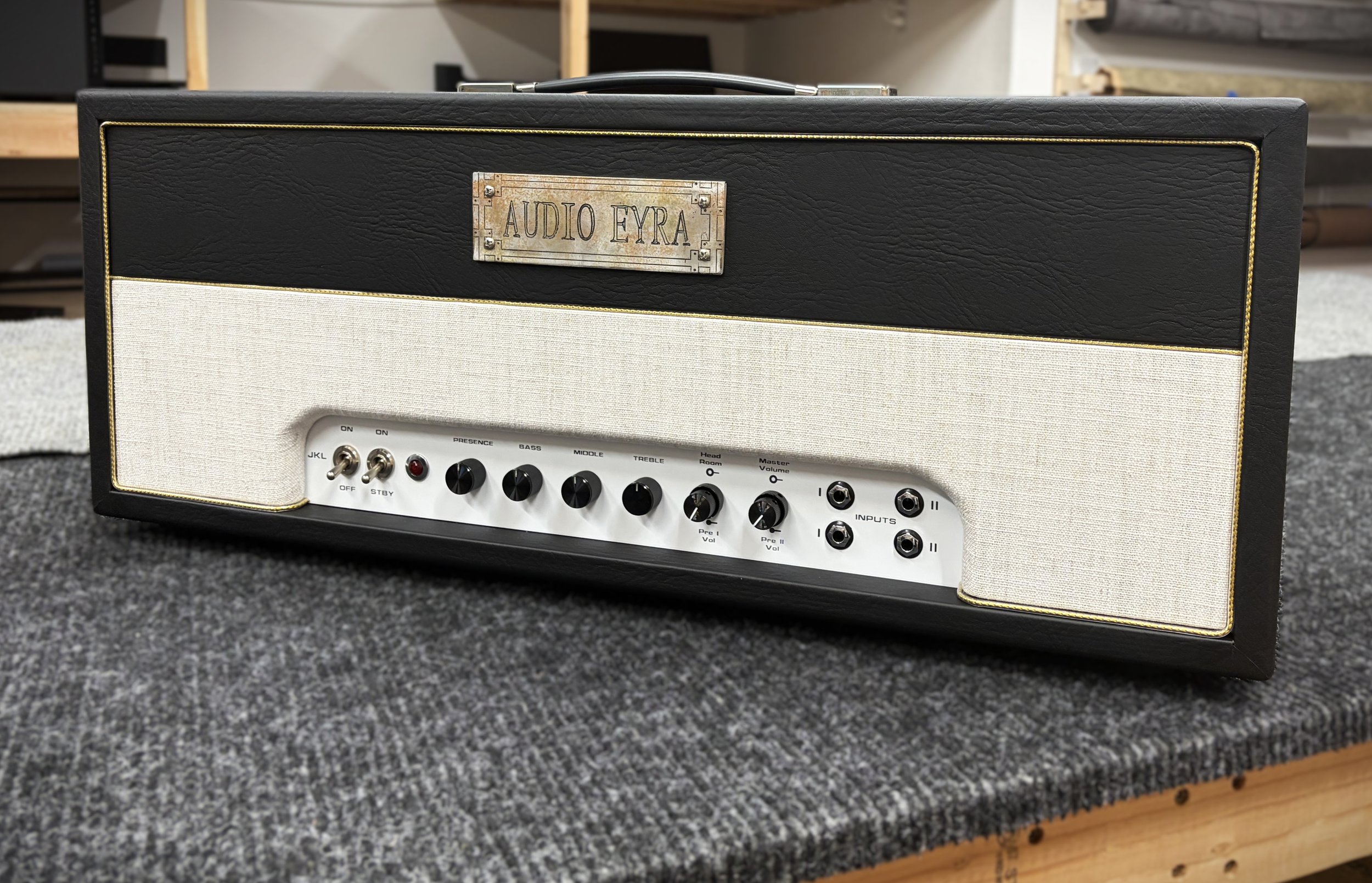
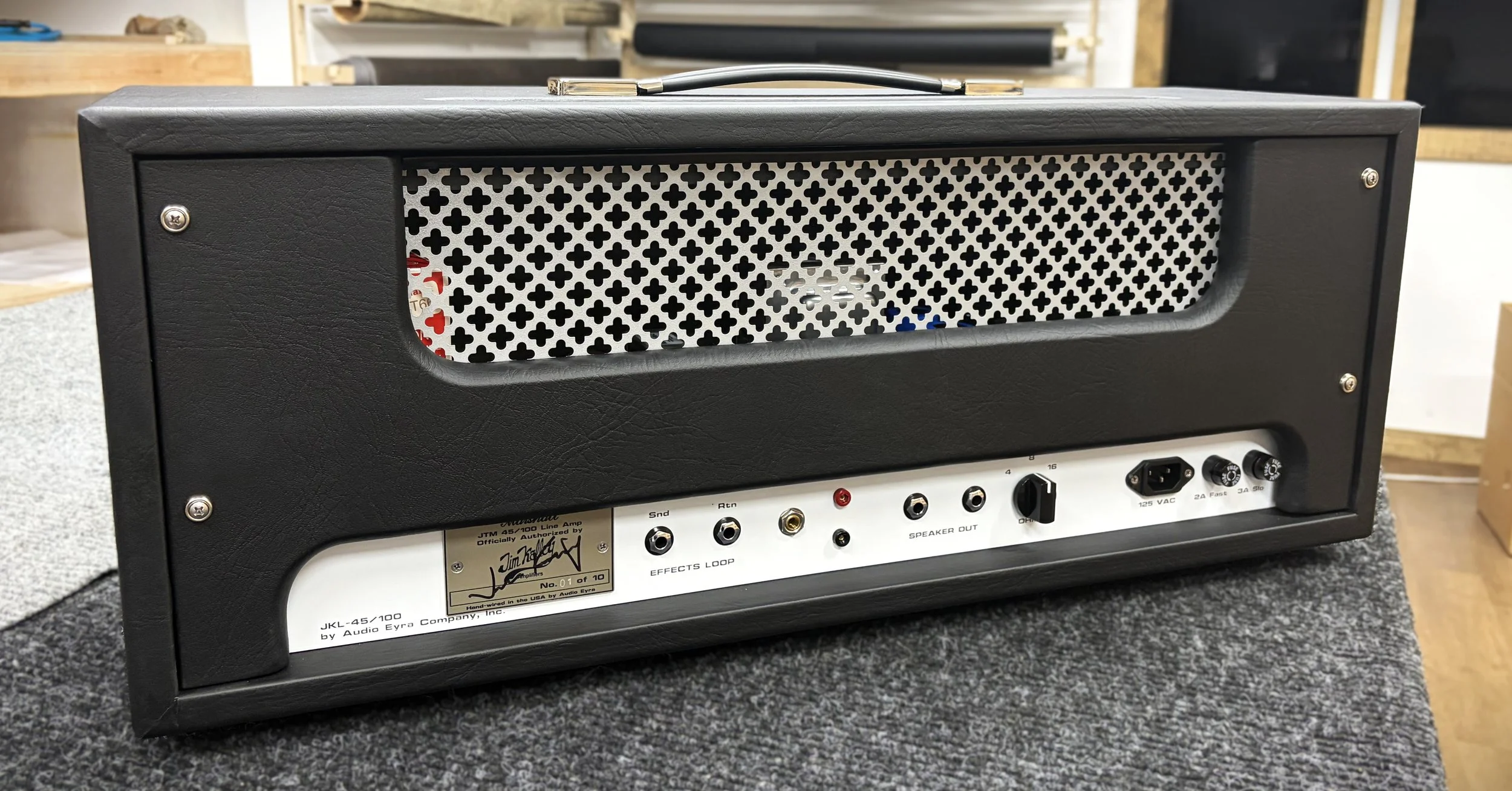
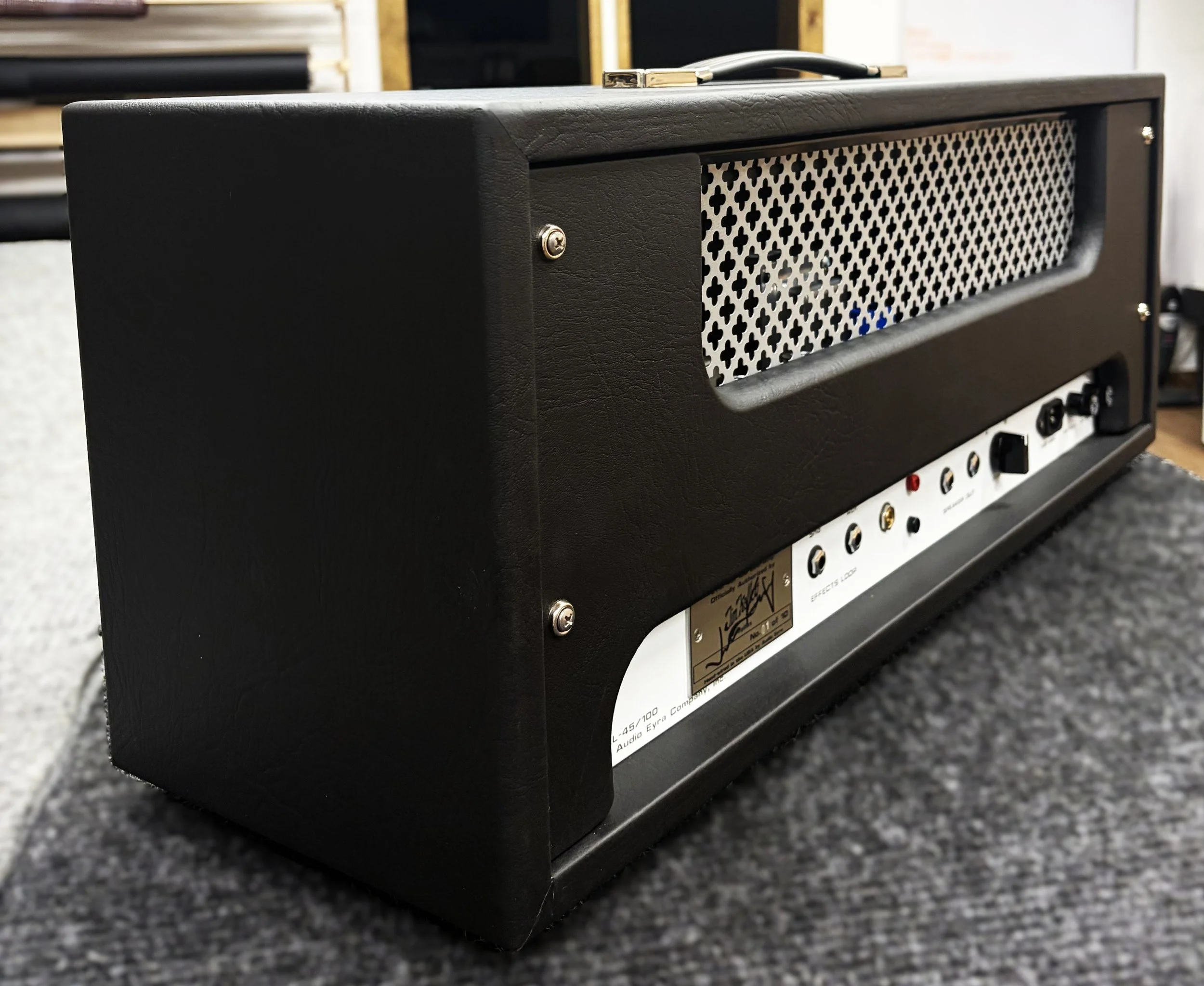
The JKL-100 is the Jim Kelley Line circuit — the same licensed, serialized preamp Audio Eyra builds into the JKL-45 — realized as a ground-up instrument. There are no donor conversions on this run. Every JKL-100 is built from scratch, by hand, to Audio Eyra’s layout and parts standard.
Four KT66s into a single output transformer deliver ~88 watts: the real JTM-45/100 architecture, the same power-section form that Hendrix used. The Line stage still does what Jim Kelley designed it to do — put that overdriven quartet’s odd-order harmonic signature in the preamp so you can have the cranked 100-watt voice at any volume, with master and Headroom where they belong.
This is not a louder JKL-45. It is the limited JKL: four bottles, one output transformer, eighty-eight watts, ten serials. When they are gone, they are gone.
Here’s some history on the beginning of Marshall’s iconic sound.
The JTM-45 is not a single frozen schematic. It is a Bassman-derived circuit that Marshall kept changing as parts, tubes, transformers, and stage volume forced the design forward. The JTM-45/100 — four KT66s and, after a brief dual-OT experiment, one output transformer — is the branch your JKL-100 is pointing at.
Origin (1962–63)
Jim Marshall’s shop was selling imported Fenders that British players liked but could not always afford or hear over drums. Repairman Ken Bran could service them; he could not invent a circuit from scratch. He brought in Dudley Craven, an EMI apprentice, with Ken Underwood joining shortly after on chassis work. They used the 1959 Fender 5F6-A Bassman as the template — long-tailed-pair phase inverter, shared cathode on the first two stages, cathode-follower tone stack, presence network off the output transformer.
Six prototypes. Jim Marshall rejected the first five. Number six was the sound: aluminum chassis in the head, closed-back 4x12 with Celestions rather than Fender’s open 4x10 with Jensens, and enough gain that the amp broke up earlier than the Bassman. First live test is usually placed at the Ealing Club in 1963. The name is Jim and Terry Marshall plus a claimed 45 watts RMS — honest RMS rather than a peak-power boast. Early production was garden-shed work, not a factory line.
What Actually Differed From The Bassman
The topology is the same. The voice is not.
- V1 tube. Bassman used a 12AY7 at the input. Marshall used ECC83 / 12AX7 throughout. Higher gain, earlier saturation, more harmonic content on the first stage.
- Negative feedback. Bran later said Dudley gave the circuit a large amount of feedback and that this changed the harmonic content. The NFB tap on early JTM-45s is taken from the 16 Ω winding into a 27 kΩ resistor and 5 kΩ presence pot — same values as the Bassman on paper, different winding and different transformer, so a different loop. Later Marshalls move the tap (16 → 8 → 4 Ω) and raise the feedback resistor, which is one reason “Plexi” is brighter and tighter than a JTM-45.
- Power tubes. First units used US surplus 5881 / 6L6. British supply pushed the switch to GEC KT66 around 1964–65. KT66 is a beam tetrode in the 6L6 family, but the bottle, plate structure, and typical operating point made the amp fatter and more “British.” Measured clean power on a pair of KT66s in that circuit is often closer to the mid-30s than a true 45; the 45-watt figure is the overdriven / mismatched neighborhood.
- Rectifier. JTM-45 stayed GZ34 tube-rectified. Sag is part of the feel. The 100-watt versions dropped the tube rectifier almost immediately.
- Mixing resistors. Early 270 kΩ mixers after the first stages; later raised to 470 kΩ (around late 1966), which changes how the two channels interact when jumped.
- Bright cap and voicing. Not consistent. Some early units have no bright cap; others 100 pF; Bass-voiced stacks use 56 k / ~250–270 pF. Lead voicing and the later Super Lead split-cathode circuit come after the classic 45 period.
- Transformers. Radiospares Deluxe first (a general-purpose iron, not a purpose-built guitar OT), then Drake and Dagnall. Primary impedance for a two-KT66 45 is high (often discussed around 6.6–8 kΩ plate-to-plate). That iron is as much “the circuit” as the tube complement.
Cosmetic and mechanical changes — polarity switch deleted, jack spacing widened, “JTM 45 MK II” on the panel — do not rewrite the schematic, but they mark the production versions most people mean by “JTM-45.”
The 100-Watt Fork: JTM-45/100 (1965–67)
This is the circuit that matters for a four-KT66, single-OT amp.
Pete Townshend wanted the JTM-45 twice as loud. Mid-1965, Bran and Craven started stacking the same preamp onto a bigger power section. The path was messy:
1. Experimental quad of 6L6/5881 with one GZ34 and a Radiospares Deluxe OT — about 60 W, transformer melted.
2. Dual GZ34s, four 5881s, two 30-watt Radiospares OTs in parallel — proved the preamp would drive a quartet.
3. Four KT66s, still dual OTs (Drake 784-74, 50 W each), silicon diode rectifier instead of bottles. That is the first real “100.”
4. September 1965: Drake ships the 1202-84, a single 100-watt OT. Dual-OT production ends. Four KT66s into one transformer becomes the form.
Early examples still wore leftover JTM-45 plexi faceplates, which is why collectors call them JTM-45/100. Rear silk-screen said Super 100. Chassis is larger so four bottles can breathe. B+ is much higher than a 45 — originals are often cited around 560 V on the early 3-inch Drake PT, which is why vintage KT66s and careful modern iron matter. Primary impedance for a correct 45/100 OT is typically discussed around 4 kΩ plate-to-plate (half the two-tube 45), which is why dropping EL34s into a 45/100 OT or KT66s into a Super Lead OT is not a free swap.
Claimed output on a vintage quartet is “100 watts.” In practice a well-set four-KT66 45/100 often lands in the 80–90 W region depending on B+, bias, and OT. 88 watts is a credible, conservative number for that architecture — not a marketing inflation of a 45, and not a later EL34 Super Lead either.
Hendrix used this family: JTM-45/100 with the single Drake 1202-84 is the amp commonly tied to the “Are You Experienced” period; later he is on transitional and Super Lead 100s. One documented Hendrix-associated 45/100 (the Dickinson amp Marshall studied) had a 33 k / 500 pF tone stack instead of the stock 56 k / 250–270 pF Bass stack — a real but narrow “Hendrix mod,” not a different power section.
What Happened After
- 1966–67: EL34s replace KT66s as GEC supply dries up. JTM-50 panels appear on two-tube amps. 100-watt amps follow the same tube change. Solid-state rectifier is standard on the 100s.
- 1967–68: JMP panels, then the Super Lead preamp: split cathode (820 Ω / 330 µF on Normal), brighter Lead channel, different filtering. That is a different voice than a JTM-45 or 45/100 even when the box still says 100 watts.
- Filtering, screen resistors, NFB tap, and OT primary keep moving. “Plexi” is a family, not one circuit.
So: a two-KT66 GZ34 JTM-45, a four-KT66 diode-rectified single-OT 45/100, and a four-EL34 Super Lead share a preamp “shape” and a company name. They do not share operating points, iron, or harmonic behavior.
Why The 45/100 Form Still Matters
The JTM-45 defined Marshall by taking an American bass amp, raising front-end gain, changing the speaker load and feedback, and then letting British tubes and iron do the rest. The 45/100 is the same preamp idea with the power section Townshend forced into existence: four KT66s, no tube rectifier, eventually one OT. That quartet’s odd-order grind when the power amp is working is exactly the spectrum Jim Kelley later said the Line Amp circuit was built to imitate in the preamp — which is why putting Kelley’s stage in front of a four-KT66, single-OT, ~88 W chassis is historically coherent rather than a random “bigger 45.”
A Few Words From Jim Kelley About This
'The voice of an amplifier is controlled primarily by three things: the frequency response, the harmonic response, and the dynamic response. The dynamic response is how the amp responds to pick attack - in other words the ADSR parameters. The tone controls shape the frequency response, and form much of the voice of the amp. But the real signature of the amp; the thing that separates one type of amp from another is its harmonic response - the way it distorts when it's overdriven. The archetypal tone of an overdriven 100-watt Marshall pretty much defined the sound of rock and roll, but controlling the volume has been a perennial struggle. An overdriven push-pull quartet of power tubes produces a unique characteristic signature. It comprises a series of primarily odd-order harmonics, and the Line Amp circuit is designed to generate precisely this spectrum of harmonics. The advantage of incorporating the Line Amp circuit into the preamp of the Marshall amp is that the signal level is easily controllable. And because of the way the circuit gets pushed into overdrive, it behaves dynamically the way a power amp circuit behaves. Since the Line Amp circuit is driven by the stock Marshall cathode follower tone stack, the amp sounds like a typical cranked Marshall at any volume level. The power section in the amp serves primarily to drive the speaker as it normally would, so it's similar to using a re-amping system but without the complexity.' - Jim Kelley
This Marshall circuit is like no other you've ever played. When Jim says it's more harmonically rich, it's an understatement. Enjoy!
Ground-up Build Amplifier:
Ten amps. That is the entire run. Few slots available. Inquire for pricing.
Audio Eyra JKL-100